
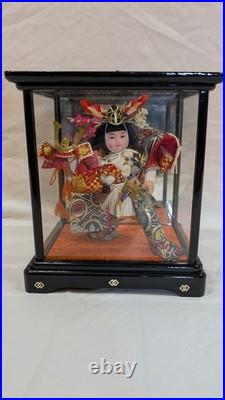
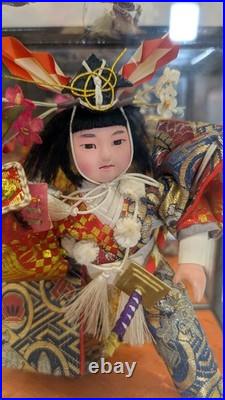
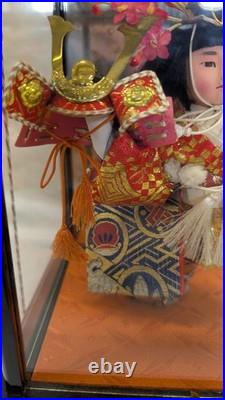
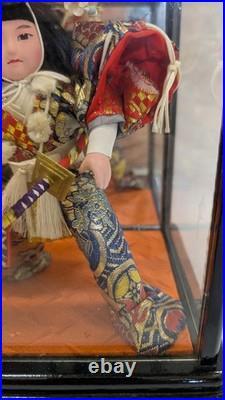
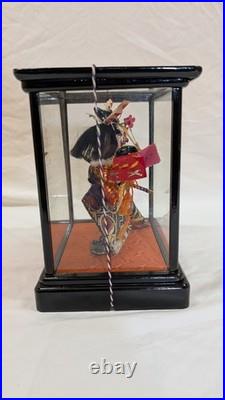
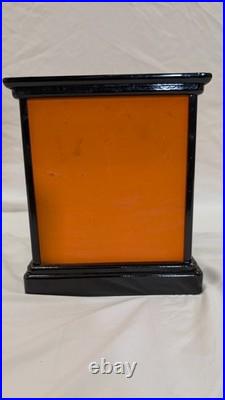
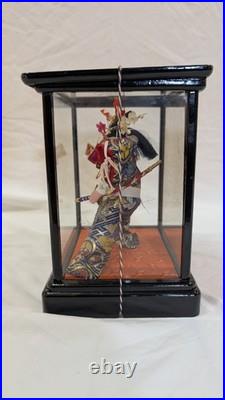
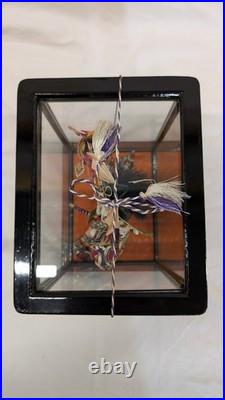
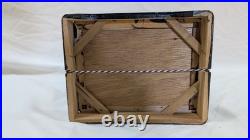
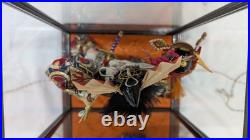
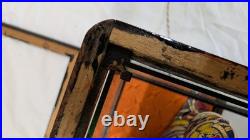
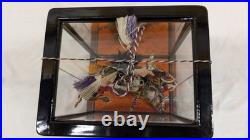

This image displays a vintage. , commonly referred to as a. Samurai Boy’s Day Doll. ? Historical Significance & Symbolism. Children’s Day Festival. These traditional dolls are displayed annually in Japan during. (Boys’ Day / Children’s Day), celebrated on May 5th. They are meant to express the family’s hope that their sons will grow up healthy, strong, and resilient. This doll depicts a young, spirited male child styled as a samurai warrior. He wears a decorative silk brocade kimono outfit paired with traditional armor. Beside him rests a mini. (samurai helmet) decorated with floral sprigs. He holds a unsheathed. (sword) in an dynamic, athletic martial stance. The piece is safely housed inside a glass and black lacquer wood display case, featuring a vibrant orange fabric platform to highlight the doll’s pose. Fine Details Obvious in the Close-Up. The smooth, porcelain-like complexion is traditionally created using. A paste made from ground oyster shells and bone glue. The features are delicately hand-painted, showcasing a soft yet resolute expression suited for a young warrior. The doll wears an stylized crown element with orange-and-white folded fan patterns. And gold cord accents. , complemented by small floral blossoms mirroring plum or cherry twigs. The kimono layers feature heavy metallic embroidery, complex brocade patterns. , and checkered gold-and-red patterns. You can also clearly see the gold hilt. And purple cord wrap. Of the miniature katana resting at his waist. Key Details Visible from Above. From this angle, you can see how the doll’s body dynamically twists. The wide stance and extended left leg create a strong diagonal line across the orange fabric base. The black lacquer crown piece, the delicate gold. Cord knotting, and the symmetrical placement of the folded fan wings are completely visible. This view clearly isolates the doll from the separate. (samurai helmet) resting on its stand to the right, showcasing the deliberate spacing used to prevent the delicate silk and floral elements from crowding or rubbing against each other. Manufacturing Insights From the Base. The raw wood, exposed corner stabilizing slats, and visible black lacquer smudges along the bottom rim strongly point to a piece that was assembled and finished by hand. This simple, raw wood framing style is highly characteristic of Japanese export goods and home festival items manufactured between the. 1950s and 1970s (Showa Era). [Image 1, Image 7]. Export items or mass-market household festival dolls from this era often left the bottom rough and relied on paper tags affixed directly to the glass (which frequently fell off over time). You can see how the purple-and-white. Cord safely loops into specialized notches carved into the center-left and center-right of the wooden bottom frame to stay completely taut. Otherwise, the product is non refundable. That’s why I ask potential buyers for a discussion about the condition and quality of the product.